


Every child enters the world with a distinctive neurological blueprint. While traditional education systems often rely on rigid, one-size-fits-all curricula, children with learning differences, attention hurdles, or developmental delays often find conventional classroom paces stressful and demoralizing.
Special Education is not about changing who a child is—it is about designing tailored learning pathways that honor their innate cognitive style. At Sprouting Bloom, our mission is to transform academic frustration into genuine curiosity, self-confidence, and independent mastery.
What Is Special Education in a Pediatric Clinical Context?
In multidisciplinary pediatric care, special education goes beyond basic tutoring. It involves specialized psycho-educational methodologies crafted to address specific neurological processing differences:
- Specific Learning Disabilities (SLD): Including Dyslexia (reading and phonological decoding hurdles), Dysgraphia (writing and spatial motor hurdles), and Dyscalculia (number processing challenges).
- Attention Deficit Hyperactivity Disorder (ADHD): Accommodating executive function, working memory, and impulse regulation to maintain sustained focus.
- Autism Spectrum Conditions: Utilizing structured visual schedules, social stories, and predictable learning routines.
- Global Developmental Delays: Breaking down complex concepts into manageable, milestone-based learning blocks.
The Cornerstone: Individualized Education Plans (IEP)
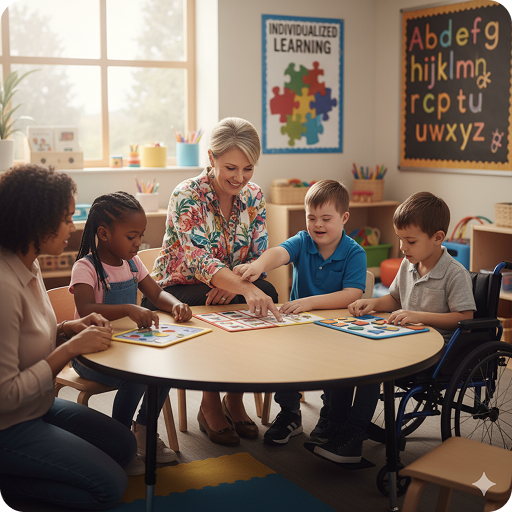
A successful special education program always begins with a comprehensive baseline assessment. We craft an Individualized Education Plan (IEP) detailing measurable goals, specialized pedagogical tools, and adaptive modifications tailored to the child's strengths rather than their deficits.
Common Signs Your Child May Benefit from Special Education
Parents and educators often notice persistent challenges that standard classroom tutoring does not resolve. You should consider a clinical evaluation if you notice:
Key Educational Indicators
- Difficulty connecting letters to sounds or recognizing basic sight words despite consistent exposure
- Extreme resistance or anxiety surrounding reading aloud, writing assignments, or math homework
- Struggles remembering multi-step instructions (e.g., forgetting the first step by the time they reach the second)
- Significant discrepancy between bright verbal vocabulary and poor written test performance
- Reversing letters or numbers persistently well past the expected developmental age
- Frequent emotional meltdowns or feelings of inadequacy linked to school performance
Multi-Sensory Teaching: The VAKT Approach
Children with diverse learning styles grasp concepts more readily when multiple sensory channels are activated simultaneously. At Sprouting Bloom, our special educators employ the VAKT method (Visual, Auditory, Kinesthetic, and Tactile):
- Visual: Graphic organizers, color-coded word families, and mind maps to organize thought flow.
- Auditory: Rhythmic phonics chants, verbal repetition, and audio-assisted storytelling.
- Kinesthetic: Full-body movement games, tracing letters in air, and jumping on number lines.
- Tactile: Tracing sandpaper letters, forming letters in textured sensory sand, and handling geometric blocks.
Bridging Clinic, School, and Home
True progress happens when interventions are consistent across every environment. At our centers in Howrah and Dum Dum, our special educators collaborate directly with parents and school teachers. We supply practical classroom accommodation plans—such as extra time on exams, quiet testing corners, and reduced written copy work—allowing children to demonstrate their true intellect without unnecessary cognitive barriers.